

Factories are increasingly using robots to help workers complete difficult and repetitive tasks. However, in many workplaces, people and robots still work separately for safety reasons.
Robots usually finish one task before handing the work over to a person.
This limits how closely they can cooperate and means workers still have to lift, carry, and inspect heavy parts by themselves.
Now, researchers at the Technical University of Munich (TUM) have developed a new system that allows humans and robots to work together more closely and safely.
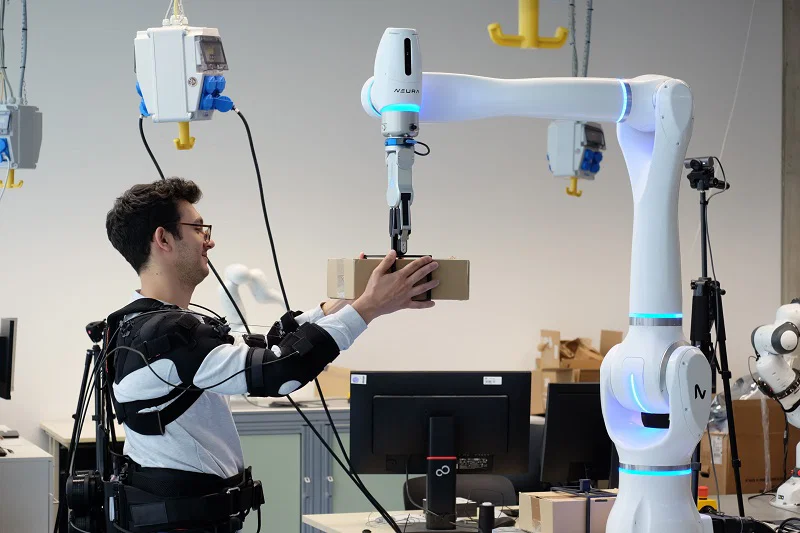
Their technology combines a wearable exoskeleton with a robotic arm, helping workers lift heavy objects with much less physical effort.
The new system, called WearaCob, combines the words “wearable” and “collaborative.”
It was developed at the Munich Institute of Robotics and Machine Intelligence and is designed to reduce muscle strain while making factory work more efficient.
The exoskeleton is worn like a backpack. An electric motor sits on the wearer’s back, while strong cables run over the shoulders and connect to supports near the elbows.
When the motor pulls on the cables, it assists the wearer’s arm muscles, especially the biceps, making it easier to lift and hold heavy objects.
Working alongside the exoskeleton is a collaborative robot, often called a cobot. Unlike many industrial robots that are locked behind safety barriers, cobots are designed to safely work close to people.
They automatically slow down when they approach a person, reducing the risk of accidents.
The two devices communicate wirelessly. When the cobot picks up an object before handing it to the worker, it measures the object’s weight. It then sends this information directly to the exoskeleton. The wearable device immediately adjusts the amount of support it provides, helping the worker carry the extra weight with less effort.
Tests showed that the system can reduce the strain on the upper arm muscles by as much as 65%. This could make a significant difference for factory workers who spend many hours lifting, moving, or inspecting heavy components every day.
The system can even handle uneven or awkwardly shaped objects. The robot calculates the center of mass of each item and tells the exoskeleton how the weight is distributed. This allows one arm to receive more support than the other, helping workers balance loads more comfortably and safely.
The exoskeleton can also work by itself without the robot. Normally, this type of wearable uses sensors attached to the user’s muscles to measure how much assistance is needed. While this method is very accurate, attaching sensors every time a worker uses the device is inconvenient in a busy factory. The new robot-assisted approach removes much of this extra setup by automatically providing the correct level of support based on the weight of the object being handled.
Another important advantage is that the cobot is easy to teach. Instead of writing computer code, workers simply guide the robotic arm through the desired movement by hand. The robot remembers the motion and can repeat the task later.
The researchers believe this technology could make factories safer, reduce worker fatigue, and improve productivity.
By allowing humans and robots to work together naturally, systems like WearaCob may help create a future where people can perform demanding jobs with less physical strain while still benefiting from human skills and judgment.













Leave a comment