
The economic potential of the sites is significant. A recent report by techUK suggests data centres have “the potential to contribute an additional £44 billion to the UK economy by 2035”.
However, the vast scale of the developments and their impact on the environment has led to huge concerns from local communities.
An abundance of cheap renewable power, cooler temperatures that cut cooling costs, and land far cheaper than the south-east of England has made Scotland attractive to data centre developers.
Fintan Slye, chief executive of the National Energy System Operator, has openly urged firms eyeing gigawatt-scale sites to look north of the border.
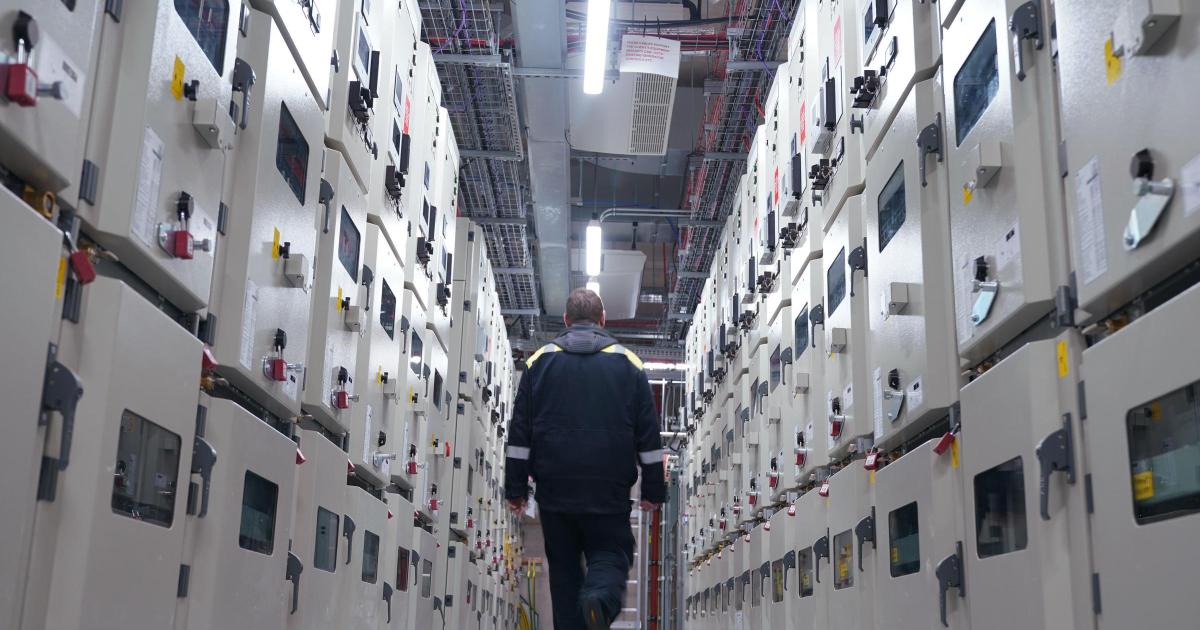
A data centre is a building packed with servers and computing equipment that underpins everyday digital services such as online banking, cloud storage and AI.
The hyperscale facilities at the centre of this debate are vast versions of the same thing.
Currently, there are 17 hyperscale data centre proposals moving through Scotland’s planning system.
They include the Cato data centre in Auchtertool, Fife. The buildings that make up this proposed site would cover an area of 280,000 square metres, equivalent to almost 40 football pitches.
The main data centre buildings would be up to 35 metres high, roughly equivalent to the height of a 12-storey block of flats.
The proposed Larbert data centre campus includes two data centre buildings with a floor area of 128,863 square metres and a building height of 25 metres. It also includes an 11,500 square metre electricity substation and associated facilities.
Hyperscale data centres are major consumers of electricity.
The developer of the Cato data centre states that annual electricity consumption will start at 400GWh per year and potentially rise to 4,000GWh per year, equivalent to 7.7% of all electricity generated in Scotland during 2024.

Writing in Scotland on Sunday, Mr Begbie said data centres had been “hijacked by politics, minority vested interests and false information”, and that Scotland risked losing out on a “generational” economic opportunity if it did not embrace the technology.
He argued that Scotland already hosts 23 data centres, including five in Edinburgh, which have “quietly powered our daily lives for years without incident”, and said financial services firms pioneering algorithmic trading and fintech — a sector worth £17.7 billion a year to the Scottish economy — would be “much better served” by modern digital infrastructure based at home.
“Against a backdrop of constrained public finances and increasing demand, the need for technology to make our services more efficient will only increase.
“The fact of the matter is that if we want our education system to thrive, our health services to keep up with demand and our economy to grow, we must embrace the potential of technology, we have no choice.
“Of course, the ethical, environmental and societal considerations of this transition must be managed sensitively.
“However, the current debate has lacked the voice of business and has been relatively fact free. Essentially the discussion has been hijacked by politics, minority vested interests and false information.
“Whether we emerge from this transition a stronger, more prosperous and fairer society depends to a significant extent on decisions being taken right now in the corridors of power.”
Mr Begbie said decisions on data centres needed to be “underpinned by a proper understanding of how our society is already dependent on digital infrastructure and how our future economic success will be determined by Scotland’s willingness and ability to embrace change and investment”.
“These are decisions of national importance for economic growth, resilience and security, and we should treat them so by designating data centres as critical national infrastructure,” he added.
“As such, we should remove decisions around planning of these projects away from local authorities and the petty point scoring politics, and bring these decisions of national importance into central government.”
Kat Jones, director of charity Action to Protect Rural Scotland told The Herald that while it was right that Scotland already hosted a number of data centres, these were not the massive sites currently in development.
“We have always been clear that our campaign is about a moratorium on specifically hyperscale AI data centres until we have done the necessary background research on their impacts and have put in place the right policies and governance.
“This is because of the sheer scale and environmental impacts: there are currently 6,200MW in planning or pre-planning, which would more than double Scotland’s power demand.
“They also bring extremely limited benefits, famously employing extremely few people, while profits flow to the US AI tech giants which are creating the AI that is actually reducing jobs and prosperity in our economy.”
Ms Jones added: “Our business leaders should be able to tell the difference between the data centres that are helpful to our economy by hosting cloud computing, driving university and medical research, and our business and banking activities, and the hyperscale AI data centres.
“It is not a difficult distinction to make: it is made obvious in their planning applications.”

A briefing published by the Scottish Parliament Information Centre (SPICe) last month found that the pace of hyperscale data centre proposals had “outpaced national and local planning policy development in Scotland”.
Speaking at First Minister’s Questions last month, John Swinney said he was “giving active consideration” to introducing national planning guidance to balance the expansion of hyperscale data centres against Scotland’s energy and climate commitments.
He also indicated that he was considering whether such decisions should be taken at a national rather than local level.
















Leave a comment