
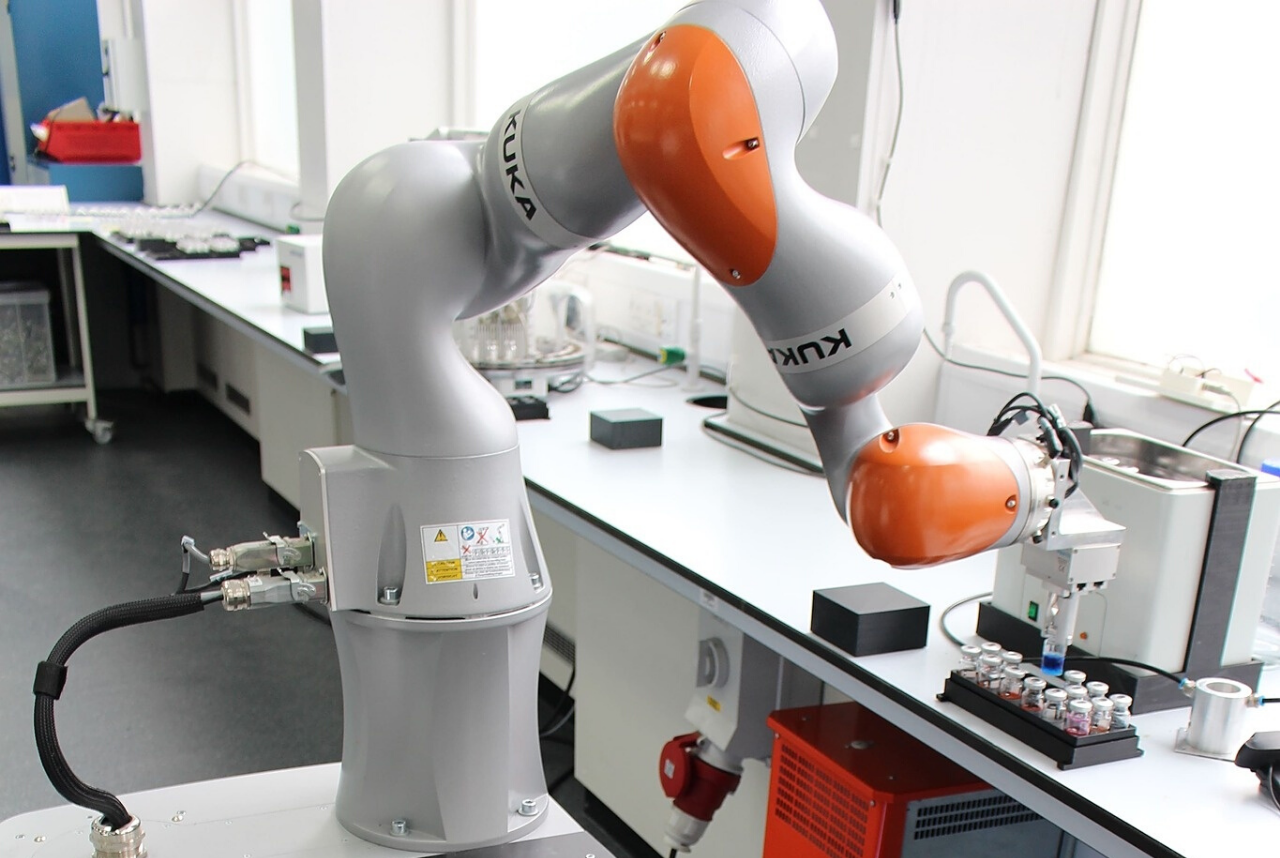
Even though the majority of resources and efforts from the scientific community have been redirected to help end the COVID-19 pandemic, there are several ongoing projects that could eventually aid the healthcare industry. In fact, one recently produced groundbreaking result could potentially revolutionise how studies are carried out in the future. Reports reveal that an autonomous machine has successfully completed its first experiment without any external input. Advanced artificial intelligence allowed the robot chemist to discover a unique type of photocatalyst that is polymeric in nature.
The algorithm and platform that made it happen were developed by researchers from the University of Liverpool. Much like how some sophisticated problems are ultimately resolved with the help of distributed computing contributed by several systems or a supercomputer, it relies on innovative machine learning. It’s mechanised limbs can produce humanoid movements which makes it compatible with standard laboratory equipment and procedures.
What normally takes a team of brilliant minds weeks or up to years can be reduced substantially as the 400 kg robot can purportedly support 10-dimensional thinking, which the human mind will struggle with, in a typical scenario. Moreover, it can continuously operate for up to 21 hours at a time and only power down to recharge to full capacity and pick up where it left. The abstract was published in the scientific journal Nature, which discusses the nuances of the experiment.
“Our strategy here was to automate the researcher, rather than the instruments,” stated the University of Liverpool’s Department of Chemistry and Materials Innovation Factory Professor Andrew Cooper. “This creates a level of flexibility that will change both the way we work and the problems we can tackle.”

Photo: University of Liverpool
He went on to describe the robot as “this is not just another machine in the lab: it’s a new superpowered team member, and it frees up time for the human researchers to think creatively.” The by product of the relentless series of experiments it performed is identified as a “polymeric photocatalyst,” which supposedly outpaces existing ones six-fold. This is speculated to be one of the many firsts it is expected to discover in the years to come.
















Leave a comment