
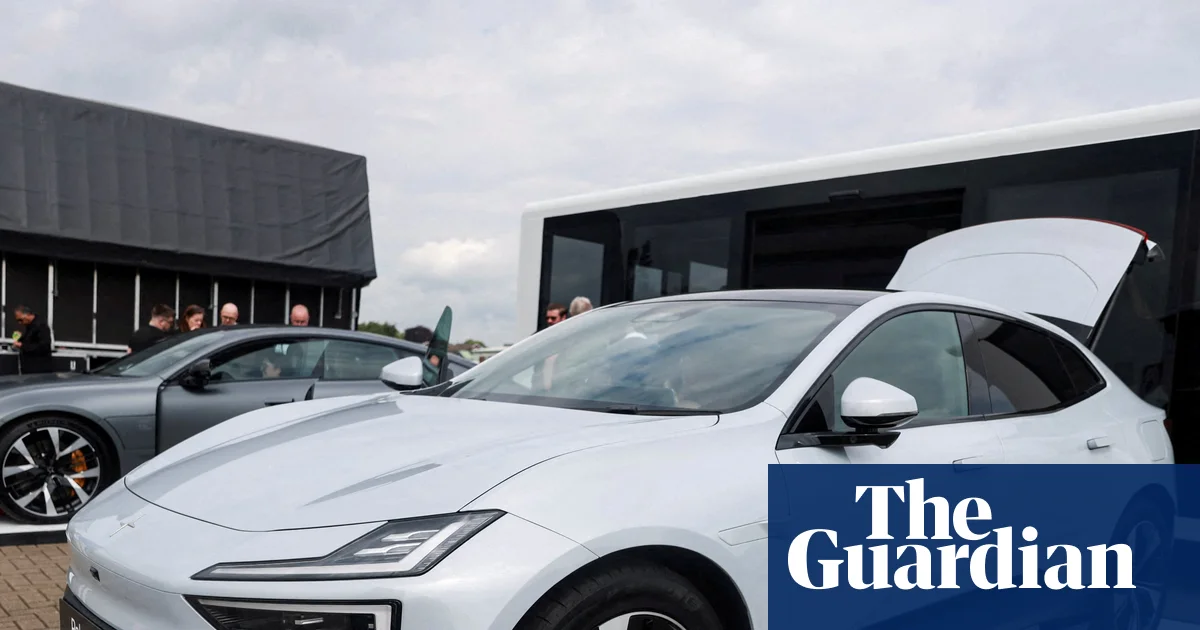
The UK government’s plans to further weaken electric car targets have provoked a furious backlash from the charging industry and the electric car brand Polestar, which would lose out from the changes.
The government is expected to dilute rules known as the zero emission vehicle (ZEV) mandate. Government sources have said it will reduce a target for pure electric cars from 80% of all sales by 2030 to 50%.
The Labour government had already weakened the mandate last year by introducing loopholes – known as “flexibilities” – that allow the sale of more plug-in hybrid electric vehicles (PHEVs), which combine an engine with a small battery.
The slower shift to electric cars would be a huge blow in particular to the charging industry, which is investing on the basis of future demand.
Greg Jackson, the chief executive of Octopus Energy, said the government had chosen “short-termist incumbent lobbying instead of the long-term future of industry”.
As well as being the UK’s largest retail energy provider, Octopus is also a large player in electric vehicle leasing and charging.
“The fossil fuel market is shrinking globally and our best hope is to speed up development of electric vehicles, not go the other way,” Jackson said. “This hesitation undermines the credibility of government commitments which were supposed to give certainty to investors.”
Delvin Lane, the chief executive at InstaVolt, which runs a network of ultra-rapid chargers, said: “Charging investment runs on long lead times, and operators need a stable, credible policy framework to plan, build and attract capital. We would urge government to work closely with the charging sector as it finalises any changes.”
Vicky Read, the chief executive of the industry lobby group ChargeUK, said weakening the target was an “astonishing” proposal which could cost tens of thousands of jobs in the longer term.
“The charging sector has ploughed billions into putting chargers in the ground on the basis of this policy, ahead of profitability,” Read said.
“This government said it would not flip-flop like the previous did. To move the goalposts again would be exactly that – an act of self-harm denying the country a forward-facing, economically prosperous industry leaving us behind the rest of the world.”
The proposal would probably mean millions more cars with petrol engines on British roads and significantly higher carbon emissions. Plug-in hybrids produce about 135g of carbon dioxide per kilometre driven on average, compared with about 166g from petrol cars, according to T&E, a thinktank monitoring transport and environmental issues. Electric cars produce zero carbon directly and have much lower associated emissions over their lifetime.
The government’s decision followed heavy lobbying by car manufacturers as well as the Unite union, which represents many workers in British automotive factories. Unite’s general secretary, Sharon Graham, described the proposed changes as “a huge victory” and said it would “protect the jobs of UK automotive workers”.
However, Anna Krajinska, the UK director at T&E, argued that allowing more plug-in hybrid sales would ultimately harm the UK industry by leaving the door open to Chinese manufacturers.
China’s Chery, owner of brands including Omoda and Jaecoo, and BYD, the world’s biggest electric carmaker, have sold about 30,000 cars each in the UK this year, many of them PHEVs.
“Slowing down targets and increasing hybrid sales will destroy the UK’s automotive sector,” Krajinska said.
“Only a rapid transition to battery electrics can secure the future of UK manufacturing. For that to happen targets have to remain unchanged and [the business secretary] Peter Kyle needs to deliver a coherent and robust industrial policy to transition the sector and jobs.”
A weaker ZEV mandate would also represent a blow to manufacturers focusing on electric cars.
Matt Galvin, the UK managing director of the Chinese-owned electric brand Polestar, said: “Weakening these targets allows car manufacturers to decelerate development of EVs at a time when they should be doing exactly the opposite and accelerating their investment and product offering.”
A Department for Transport spokesperson said: “The UK EV market is strong, but we’ve always said we’ll review the mandate to ensure taking a pragmatic and balanced approach that supports British industry and continues to drive investment.”














Leave a comment