
About three-quarters of the RAC’s revenue is tied to insurance. That helps explain why CVC wants a bigger stake rather than a stock market exit
When the owners of a £5bn business decide they would rather sell to each other than to the stock market, it tells you where they think the value is.
The RAC has reportedly shelved plans for a London float. CVC Capital Partners is expected to stay on as a major shareholder. Co-owners Silver Lake and Singapore’s sovereign wealth fund GIC are said to be in advanced talks to sell out to CVC and other investors. The deal isn’t done yet. If it goes through, a listing is unlikely for at least 18 months.
On the surface this is another blow to the London Stock Exchange. For the insurance market, the more interesting point is how much of the RAC is insurance underneath the orange vans.
More insurer than it looks
The RAC is usually described as a breakdown company. Its own accounts suggest otherwise. In its last full split of revenue, for 2022, the group classed £441m of membership revenue as insurance-related. That is mostly breakdown cover. On top of that came £59m from its insurance broking arm. Together, that is roughly three-quarters of the group’s £659m revenue.
The broking business accounts for about 9% of group revenue. It earned £70m in 2024 selling mainly motor cover through price comparison sites, and it takes no underwriting risk. The RAC says it is the largest pure-play broker brand in UK motor, despite having less than 1% of a market worth around £14bn. Separately, RAC Insurance Limited is authorised by the PRA, and the group underwrites legal expenses cover for partners including Ageas.
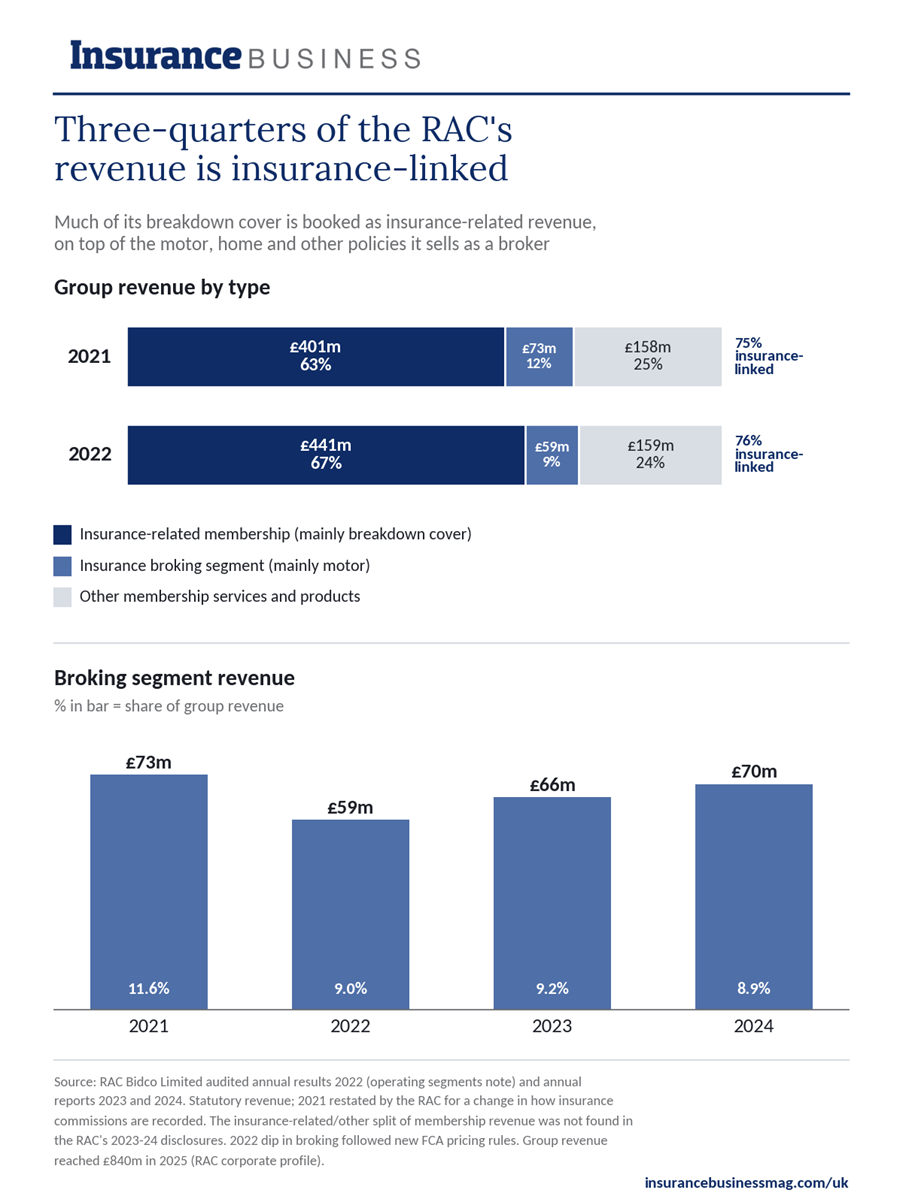
The income hasn’t always been smooth. When the FCA’s pricing rules came into force in 2022, broking revenue fell by £14m and the RAC wrote down its insurance unit by £152m. The broking arm has recovered steadily since then.
Read next: Ageas expands partnership with RAC
Why private equity loves insurance
CVC first invested in the RAC in late 2015, alongside GIC, when Carlyle sold its stake. The money came from CVC’s Strategic Opportunities platform, which is designed to hold stable businesses for longer than a typical buyout fund.
Annually renewing cover suits that approach well. Group revenue reached £840m last year. The RAC’s latest half-year figures put revenue at £463m, with membership at 15.9m. The company says it is on track for a 15th consecutive year of earnings growth.
The same predictability is what draws buyout firms to broking. Advisers told Insurance Business that distribution is asset-light and highly forecastable, because commissions return with every renewal. That makes it well suited to leveraged ownership, as covered in this analysis of UK distribution M&A.
Read next: Fewer UK broker deals, but PE is piling into specialty and MGAs
Fewer deals, bigger cheques
The RAC news fits the pattern in the broker market. According to MarshBerry, the number of UK distribution deals is at its lowest since 2017, and was 22% lower year-on-year by the end of July. Even so, July was the biggest month of 2026 by value. EQT has since agreed to buy a majority of McGill and Partners at a $2bn valuation. That same week, KKR agreed to sell USI to Aon in a deal reported at about $17bn.
Private equity is doing fewer deals but paying more for the assets it rates highest. The RAC’s owners appear to be doing the same, backing an insurance-heavy asset they know well rather than accepting whatever the public markets would offer.
Read next: EQT lands $2 billion swoop for McGill and Partners as private equity’s insurance spree rolls on
What it means for partners
For underwriters on the RAC’s panel, and for insurers that buy its breakdown and legal expenses cover, continuity is the practical takeaway. The downside is transparency. A private RAC doesn’t publish investor updates, although its listed bonds mean it will still release annual accounts.












Leave a comment