
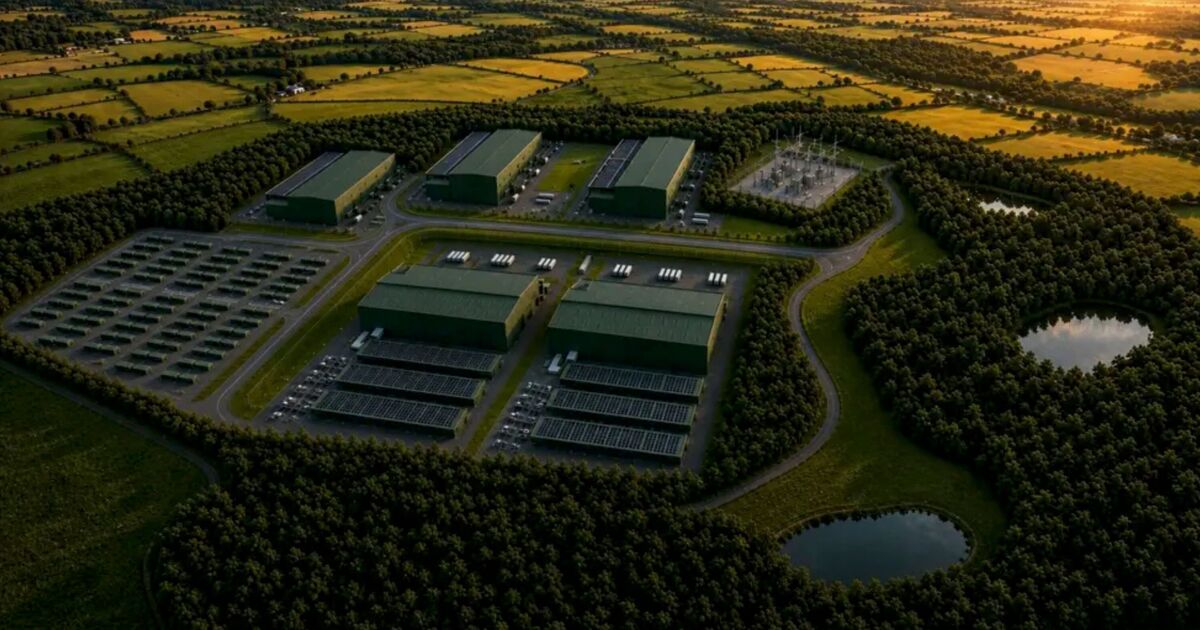

An artist’s impression of the data centre Xlinks is planning to build in the North Devon countryside (Image: Xlinks)
There is a new fight for the countryside. This time it’s not about fox hunting or flytipping or environmental practices like rewilding. The new battleground is over the massive data centres needed to drive the nation’s artificial intelligence (AI) revolution.
Britain already has some 550 to 565 operational data centres – essentially giant industrial warehouses filled with advanced computer processors – but government and industry projections show capacity needs to more than double from 1.6 gigawatts (GW) to roughly 3.3 GW to 6.3 GW by 2030. Labour has been hoping for a data centre building boom to drive economic growth.
In 2024, the government designated data centres as critical national infrastructure, meaning they are on an equal footing with water, energy and emergency services systems when it comes to planning. But campaigners fighting plans insist the UK’s AI economy must not come at the expense of Britain’s food security, rural communities and agricultural heritage.
Data centres already use more than 14 million litres of water a day in the UK and, with seven areas of England now officially in drought as a result of the heatwaves amid record low rainfall and exceptionally high temperatures, there are fears over water security. Ofgem, the energy regulator, has also raised the prospect of massive additional power demands on the National Grid from hundreds of speculative projects.
In Ireland, according to official figures from the country’s Central Statistics Office, data centres have accounted for 23% of the nation’s entire metered electricity consumption – nearly as much electricity as all residential homes across the whole country and up from just 5% in 2015. It’s not just in Europe that a battle has been brewing.
Last week, country music star Willie Nelson urged US communities to come together and “fight” plans for more server warehouses, including in Abbott, Texas, where he grew up and still has a home.
Nelson, 93, an ardent environmental activist and co-founder of Farm Aid, which has worked for more than 40 years to prevent large-scale factory farms from taking over from family-owned land, wrote in an open letter: “Our community, like many others, needs to fight against data centres invading our land. The last thing we need is a loud, water-thieving, light polluting data centre anywhere near our town, or any others for that matter.”
The singer added: “The strength of rural America has never come from big industrial footprints. It comes from generations of people, open spaces, local businesses and a connection to the land.”

A demonstrator holds a placard during a protest against data centres outside the Scottish Parliament (Image: Getty Images)
Nelson’s is a message campaigners in North Devon would wholeheartedly agree with. There is a growing backlash in the West Country over plans to turn over 850 acres of agricultural land to create a vast data campus – the largest of its kind in Europe – near the pleasant market town of Great Torrington.
Xlinks, which describes itself as a green energy company, plans to build a data centre and battery storage site which it says would deliver up to 1.5GW of AI-optimised compute capacity, create at least 650 new jobs and could be worth up to £3.6billion to the economy.
Campaigners against the plans filled a public meeting last month when the proposals were announced, with hundreds more gathered on the street outside.
The site will cover the equivalent of four average-sized UK farms, according to its opponents, with the proposed building expected to be 40 metres high.
There are also concerns about the impact on local water supplies in cooling the huge racks of computer servers which produce vast amounts of heat.
Fifth-generation farmer and Devon County Council’s cabinet member for rural affairs, Cheryl Cottle-Hunkin, told Farmers Guardian: “It would be larger than the nearby town of Great Torrington and would permanently alter the character of this rural landscape. Food security is national security, and losing good agricultural land on this scale should concern everyone.”
She highlighted environmental implications from the loss of ages-old Devon hedgerows to the destruction of wildlife habitats within a UNESCO Biosphere Reserve.
Ms Cottle-Hunkin added: “North Devon’s identity is built on farming, food production and stewardship of the land, and proposals of this scale demand the highest level of scrutiny and robust public debate.”

Country music star Willie Nelson has urged US citizens to resist data centres in their commmunities (Image: AP)
Another farmer, Barbara Fryer, told The Telegraph that water scarcity is already a problem in the area. “There isn’t the water for it,” she said. “The water table has reduced already, and you’ve just got brown grass with less livestock on it. We’re producing less food, and it’s no good. It’s really nice agricultural land, and this will wreck it.”
Campaigners are gearing up for a battle, writing to ministers and Devon MPs to call for a new Rural Impact Framework that ensures the impacts of data centre construction on food security, rural heritage and farming communities must be properly considered.
Xlinks has said it will use rainwater to cool the sites rather than drawing water from the nearby River Torridge.
Roger Mortlock, chief executive of the Campaign to Protect Rural England, said: “A site the size of 500 football pitches and with buildings as tall as Exeter Cathedral, [the data centre] would guzzle unfathomable amounts of energy and water – and be visible for miles around.
“The environmental damage done by data centres is not being considered properly by the government, which instead gives the green light to these massive infrastructure projects without taking their impact into account or thinking about how they should be done well.” MP for Torridge and Tavistock Sir Geoffrey Cox is also concerned.
He said: “I believe this project is vastly out of scale with the local landscape and infrastructure.
“It asks local communities to absorb an unfair and disproportionate burden by accommodating the largest AI data centre in Europe and one of the largest battery energy storage facilities, at a time when thousands of acres of productive agricultural land in Devon are being taken out of production for solar parks, and when we have recently learned that the grid is struggling to cope with existing demand.
“We have yet to see any detailed plans, but in its current form and, indeed, in any form likely to meet the developer’s objectives, it is difficult to see how this proposal could be considered acceptable.”
Xlinks, who have been approached for comment, have previously insisted the site will bring major economic benefits to Devon and could partially be cooled by rainwater.

Roger Mortlock, CEO of CPRE, says big corporations are ‘calling the shots’ in the UK countryside (Image: CPRE)
The fight against data centres is increasingly being waged in the courts.
In April, campaign groups Foxglove and Global Action Plan won the UK’s first legal challenge against a data centre, preventing the go-ahead of a £1billion site proposed for the Woodlands Park site in Iver, Buckinghamshire. They argued that the government and developer Greystoke had failed to properly consider the energy use and environmental impact of the sprawling 72,000 sqm site beside the M25.
The government conceded it had failed to ensure the “mitigation measures” – a promise made by the developer determining that no environmental impact assessment was required – could no longer be secured, thus creating a “serious logical error”.
Tom Hegarty, spokesman for Foxglove, said the Woodlands case set a precedent that all future mitigation measures designed to waive the need for an EIA [Environmental Impact Assessment] must be enforceablein law.”
He added: “Foxglove wants to make sure any new data centres built in Britain are actually good for Britain, not dodgy tech billionaires in the US looking to harvest our power and water, and derail our route to a secure, renewable energy future – as climate change-fuelled wildfires rampage through Suffolk.
“New data centres should only be built if they don’t cause harm to our climate or our critical supplies of drinking water – or jack up the price of power.
“Big tech must not be allowed to stack up billions in profits while leaving the rest of us to pick up the bill.”
The legal precedent also stipulated that developers must demonstrate to the Secretary of State that any new data centre will not cause an increase in the UK’s overall climate emissions nor an increase in national or regional water scarcity, and that the developer must build or construct a new, renewable generation and storage capacity, and any necessary grid connections to completely power each finished facility.
Without the requisite data centres, supporters of AI suggest the economic benefits to the UK will be delayed or in doubt.
But energy sector watchdog Ofgem said last week that 315 data centres are waiting to join the National Grid, collectively requiring 73GW of energy, which is far higher than the country’s peak energy demand of 45GW.
Meanwhile, critics insist AI cannot come at any cost.
The battle lines are drawn. Expect a bumpy road to revolution.














Leave a comment