Significant growth in the Global Collaborative Robot Market is driven by increasing demand for flexible manufacturing and workforce automation amid labor shortages. Opportunities exist in AI-enhanced cobot capabilities and expanding into sectors like healthcare, despite challenges with speed and payload limits.
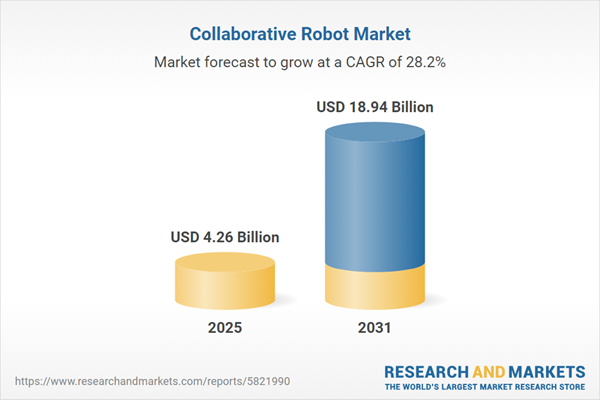
The Global Collaborative Robot Market is projected to expand significantly, growing from a valuation of USD 4.26 Billion in 2025 to USD 18.94 Billion by 2031, reflecting a CAGR of 28.23%.
These specialized automation systems are designed to operate safely alongside human personnel within shared environments without the need for physical barriers.
This market expansion is chiefly supported by the escalating demand for flexible manufacturing capable of handling high-mix, low-volume production, as well as the critical necessity to address global labor shortages. According to the International Federation of Robotics, collaborative robots achieved a market share of 10.5% of industrial robots installed worldwide in 2023, with adoption further accelerated by their rapid return on investment and ease of deployment relative to traditional counterparts.
A significant challenge impeding broader market growth is the inherent limitation regarding operation speed and payload capacity. Stringent safety regulations mandate that these robots function at reduced velocities and force levels to prevent injury during human interaction, which serves as a technical constraint. This limitation restricts their viability in applications that require high throughput or heavy material handling, effectively limiting their ability to displace faster traditional robots in mass production environments.
Market Drivers
The mitigation of global skilled labor shortages and workforce gaps serves as a primary catalyst for the market’s trajectory. As the manufacturing workforce ages and younger demographics increasingly avoid manual labor, organizations are deploying collaborative robots to maintain continuity and productivity. These systems seamlessly fill vacancies in dull, dirty, and dangerous tasks, allowing human employees to focus on higher-value activities, a need that is particularly urgent in sectors traditionally reliant on manual processes. This demand is illustrated by the Association for Advancing Automation’s February 2025 report, ‘North American Robotics Market Holds Steady in 2024,’ which noted that robot orders in the food and consumer goods sector surged by 77% in the fourth quarter of 2024 compared to the previous year, driven largely by the critical need to address persistent labor scarcity.
Simultaneously, the integration of Artificial Intelligence and Machine Learning is revolutionizing the capabilities and accessibility of collaborative systems for adaptive automation. AI-driven cobots can now adapt to variable environments, recognize objects without rigid programming, and optimize their own paths, significantly lowering technical barriers for inexperienced users.
This technological convergence is compelling manufacturers to modernize operations, as evidenced by Rockwell Automation’s ’10th Annual State of Smart Manufacturing Report’ from June 2025, which states that 95% of manufacturers have invested in or plan to invest in AI and machine learning technologies over the next five years. This commitment supports the broader ecosystem, where the International Federation of Robotics reported in 2025 that the total number of industrial robots in operational use worldwide reached 4,664,000 units in 2024, a 9% increase from the prior year.
Market Challenges
The inherent limitation regarding operation speed and payload capacity stands as a substantial technical barrier directly impeding the broader expansion of the Global Collaborative Robot Market. Unlike traditional industrial robots that operate at high velocities behind protective cages, collaborative robots must comply with stringent safety regulations that mandate reduced force and slower operating speeds to ensure the safety of human workers in shared environments. This requirement renders them unsuitable for high-throughput applications such as heavy-duty automotive assembly or rapid material handling, where maximizing cycle time is critical for profitability, often leading manufacturers to restrict these robots to auxiliary, lower-value tasks rather than replacing primary production lines.
The impact of this performance constraint is evident in the discrepancy between unit adoption and financial contribution. Since collaborative robots are engineered for lighter payloads, they command lower price points and cannot displace the capital-intensive machinery used in heavy industry. This valuation gap is reflected in recent industry statistics from the Association for Advancing Automation (A3), which reported that in the first nine months of 2025, collaborative robots accounted for 16.1% of total robot units ordered in the North American market but generated only 9.4% of the total revenue. This data underscores that while unit volume is maintaining a presence, the market’s monetary growth is significantly hampered by the technology’s inability to capture the high-value, heavy-payload segment of the industrial automation sector.
Market Trends
The Development of High-Payload and Extended-Reach Collaborative Models represents a critical market evolution, enabling manufacturers to deploy cobots in heavy-duty applications previously reserved for traditional industrial robots. This trend directly addresses the payload limitations that have historically restricted collaborative automation to light assembly tasks, opening new opportunities in palletizing, machine tending, and material handling. As industries seek to replace caged robots with more flexible solutions, demand for these robust systems has surged, as highlighted by The Robot Report in September 2024; specifically, Teradyne revealed that the heavy-duty UR20 and UR30 models accounted for more than 20% of Universal Robots’ total sales in the second quarter of 2024, underscoring the rapid adoption of higher-capacity units.
Simultaneously, the Diversification of Applications into Healthcare, Agriculture, and Food Service is reshaping the market landscape by reducing reliance on traditional manufacturing sectors. In healthcare specifically, collaborative systems are increasingly utilized for surgical assistance, rehabilitation, and laboratory automation, where precision and safety are paramount. This expansion is driven by the technology’s ability to operate in sterile environments and work intimately with patients and medical staff without complex safety infrastructure. Validating this sectoral shift, the International Federation of Robotics reported in an October 2024 press release that global sales of medical robots increased by 36% in 2023, driven largely by the integration of collaborative technologies into clinical workflows.
Key Players Profiled in the Collaborative Robot Market
About ResearchAndMarkets.com ResearchAndMarkets.com is the world’s leading source for international market research reports and market data. We provide you with the latest data on international and regional markets, key industries, the top companies, new products and the latest trends.
Attachment
CONTACT: CONTACT: ResearchAndMarkets.com Laura Wood,Senior Press Manager press@researchandmarkets.com For E.S.T Office Hours Call 1-917-300-0470 For U.S./ CAN Toll Free Call 1-800-526-8630 For GMT Office Hours Call +353-1-416-8900


















Leave a comment