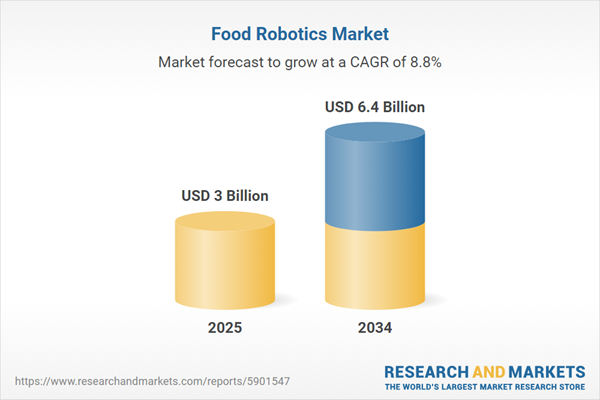
The global food robotics market is poised for impressive growth, with an expected valuation of USD 6.4 billion by 2034, up from USD 3.0 billion in 2025, representing a CAGR of 8.95% from 2026 to 2034. Europe currently leads the market with a 30.8% share, driven by labor shortages, technological advancements, increased demand for processed foods, stringent food safety regulations, and heightened consumer expectations for quality and variety.
Automation in food processing and packaging is increasingly vital to enhance efficiency, reduce costs, and ensure hygiene standards. The adoption of robotics for tasks like sorting, portioning, and quality inspection is driven by the need for consistent product quality amid labor shortages. For example, Chipotle’s testing of food-preparing robots in California highlights the trend. Rising consumer demand for packaged and ready-to-eat foods necessitates investment in robotic solutions.
In the United States, the food robotics market is powered by automation addressing labor shortages and boosting operational efficiency. Robotics play a key role in maintaining compliance with strict food safety standards and minimizing contamination risks. Increasing demand for processed foods is prompting manufacturers to streamline processes with advanced technology, including AI and machine learning for improved precision and adaptability. The deployment of autonomous food delivery robots, like those launched in Dallas, underscores the sector’s growth trajectory.
The rise in global labor shortages, evidenced by a U.S. Chamber of Commerce report highlighting millions of job openings, underscores the necessity for automation. Food robotics mitigate these shortages by automating labor-intensive processes such as packaging, sorting, and processing, offering consistent product quality, uninterrupted production, and reduced dependency on human labor.
Technological advancements in AI, ML, and vision systems significantly enhance food robotic capabilities. The proportion of companies implementing ML-driven solutions has grown significantly in the UK. The introduction of collaborative robots improves production flexibility and efficiency, addressing market needs. These robots are highly adaptable, quick to reprogram, and suitable for diverse food production requirements.
Surging demand for processed foods, fueled by consumer preferences for convenience, drives market expansion. With thousands of food processing establishments, the U.S. represents a significant market. Automated systems ensure precision and consistency, essential for maintaining product quality. Robotics facilitates quick scaling, meeting changing market demands efficiently.
Stringent food safety laws require automation to mitigate contamination risks from human interaction. Robotics ensure consistent processing, crucial for quality standards. Food robotic systems provide traceability, aiding regulatory compliance through detailed production documentation.
Escalating consumer expectations for quality and variety support market growth. California leads in food and beverage manufacturing, highlighting regional production capabilities. Robotics adoption allows industries to meet consumer desires for diverse, high-quality products efficiently. These systems can handle varying recipes and packaging, facilitating production shifts to satisfy customer demands.
The market segmentation analysis highlights articulated robots as dominant, crucial for processing and packaging due to their flexibility and precision. Medium payload robots hold a significant market share due to their versatility and stability in handling larger food items. Palletizing applications lead the market with significant shares, benefitting from robotics’ precision and speed in stacking products efficiently.
Europe’s market leadership is attributed to its advanced industrial base and regulatory landscape necessitating automation. The integration of AI and ML improves food robotics capabilities, driving regional growth. High labor costs further propel investment in robotics to enhance productivity.
The North American market grows steadily, with robotics streamlining processing and packaging, aided by advanced AI technologies. This automation supports consumer demands for convenience and customization, while sustainable practices motivate robotics adoption for waste reduction.
In the United States, robust growth is driven by automated efficiency enhancements and labor cost reductions. Consumers’ rising demand for customized products accelerates this trend, with online channels influencing purchases significantly.
Asia-Pacific experiences robust growth with increasing automation demands in food processing. Robotics enhance precision, addressing safety and quality challenges. AI-driven advancements enable flexible production, meeting personalized and on-demand food trends.
The Latin American market growth is fueled by automation adoption, sophisticated robotics, and increasing processed food demand. The Middle East and Africa witness significant market expansions, motivated by automation, food safety standards, and sustainability practices.
The competitive landscape in food robotics is characterized by intense demand for automation and technological innovation. Companies are integrating AI and ML to enhance robotics. Strategic partnerships, R&D, and tailored solutions provide a competitive edge, as shown by ABB Robotics’ partnership with Pulmuone. The emphasis on sustainability and hygiene drives advancements, with pricing and service quality influencing market positioning.
About ResearchAndMarkets.com ResearchAndMarkets.com is the world’s leading source for international market research reports and market data. We provide you with the latest data on international and regional markets, key industries, the top companies, new products and the latest trends.
Attachment
CONTACT: CONTACT: ResearchAndMarkets.com Laura Wood,Senior Press Manager press@researchandmarkets.com For E.S.T Office Hours Call 1-917-300-0470 For U.S./ CAN Toll Free Call 1-800-526-8630 For GMT Office Hours Call +353-1-416-8900


















Leave a comment