
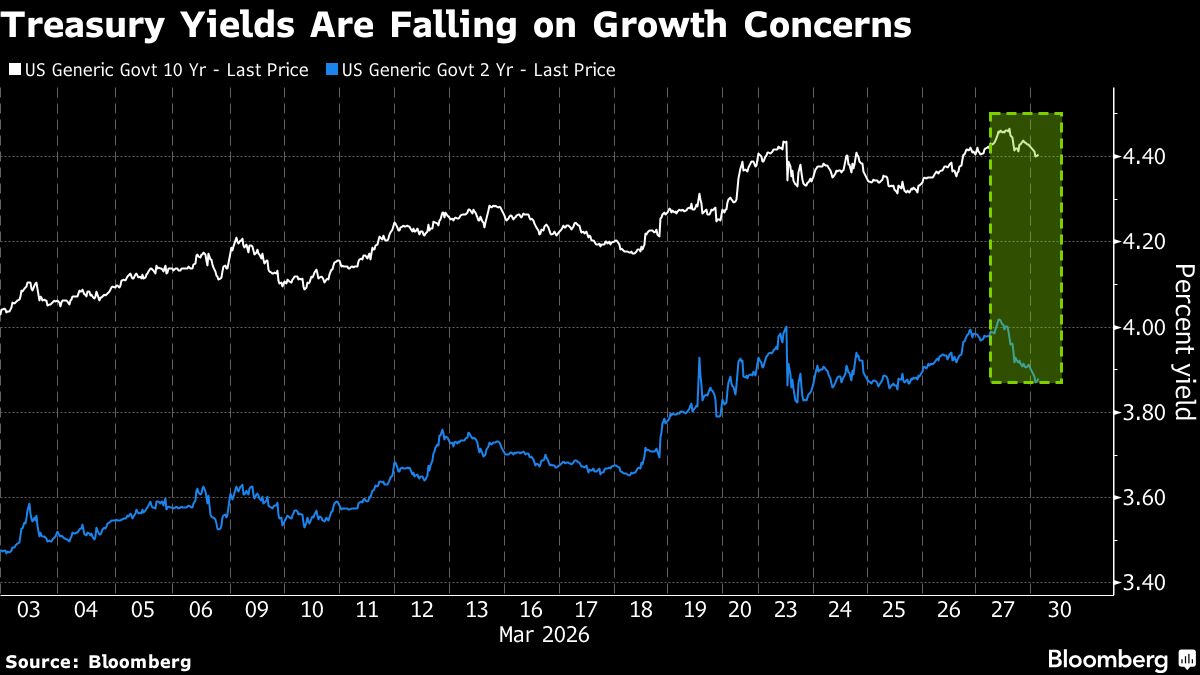
(Bloomberg) — Sovereign bonds rose around the world as concern the Middle East conflict will derail global economic growth revives demand for beaten-down government debt.
US Treasuries advanced with UK and Japanese bonds on speculation that surging oil prices may be just a harbinger of a protracted global fuel shortage. That’s helping boost demand for government debt that until recently had been under selling pressure as fears over quickening inflation outweighed their traditional haven appeal.
“The market is now letting its imagination run wild about what the world might look like in a month’s time if there is no resolution by then” to the war, said Gareth Berry, a strategist at Macquarie Group Ltd. “Parallels with Covid are already being identified as economies are at risk of shutting down — this time due to lack of fuel.”
The bond rally comes after weeks of selling that was driven by surging oil costs and concern over potential central bank interest-rate hikes. The recent shift in focus toward slowing economic growth is easing fears that central banks will need to adopt an aggressively hawkish stance to control inflation.
Yields on Treasury two-year notes, among the securities most sensitive to shifts in monetary policy, fell three basis points to 3.89%, after sliding seven basis points on Friday. Those on benchmark 10-year debt dropped four basis points to 4.39%.
UK 10-year yields fell two basis points to 4.96% while German and Japanese equivalents both declined one basis point to 3.08% and 2.37% respectively.
What Bloomberg Strategists Say…
“The bull-steepening trend is likely to extend as investors pivot toward concerns about a growth slowdown after spending much of March pricing in a war-induced surge in inflation expectations”
Garfield Reynolds, Markets Live strategist
Some of the biggest bond funds in the US including Pacific Investment Management Co. say financial markets are underestimating risks the Iran war will trigger a sharp slowdown. Goldman Sachs Group Inc. said the probability of a downturn over the coming year has risen to about 30%.
The war — now in its second month — is showing no sign of ending even after the US extended a deadline for Tehran to agree to reopen the Strait of Hormuz. This has left Brent crude on track for a record monthly increase. It was up 1.9% at $114.73 a barrel in Monday trading.
Matthew Hornbach, global head of macro strategy at Morgan Stanley recommended buying five-year Treasuries and betting on a steeper yield curve between the seven- and 30-year tenors in a note published on Friday.
















Leave a comment